
A door swings into your car in a parking lot. A shopping cart dents your fender. A hailstorm leaves small depressions across your hood. Before you assume the damage needs sanding and repainting, there may be another option: paintless dent repair.
Does paintless dent repair work? Yes, for the right damage. PDR carefully reshapes dented metal without body filler or repainting. It is often suitable for shallow door dings and hail dents when the paint remains intact. The dent’s depth, location, panel material, and accessibility determine whether it is a good candidate.
The key is choosing a repair method that addresses the entire problem. An isolated ding may qualify for PDR, while cracked paint, severely stretched metal, or underlying collision damage may require professional auto body repair in Mesa. If the finish is damaged, automotive paint matching becomes part of restoring the panel’s appearance.
Here is what PDR can fix, where its limits begin, and what affects the price.
How Does Paintless Dent Repair Work?
Paintless dent repair, also called paintless dent removal or PDR, uses controlled pressure to move displaced metal back toward its original contour.
Depending on the damage and access, a technician may use specialized rods and picks behind the panel or glue-pulling equipment on the outside. Reflection lights help reveal subtle low spots, raised areas, and distortions as the technician works.
This is a gradual process. A technician makes small adjustments across the damaged area rather than simply pushing hard against the center until the dent pops out.
An assessment typically considers:
Whether the paint is intact and firmly bonded
The dent’s depth, shape, and position
Whether the metal has been excessively stretched
Access behind the panel and the location of reinforcements
Whether the panel has previous repairs or repainting
The vehicle manufacturer’s repair restrictions
Trim or interior panels may need to be removed to gain appropriate access. “Paintless” describes the finish repair, not necessarily a process that requires no disassembly.
What Can Paintless Dent Repair Fix?
The strongest candidates generally have intact paint and metal that can be reshaped without exceeding its repair limits.
Minor Door Dings
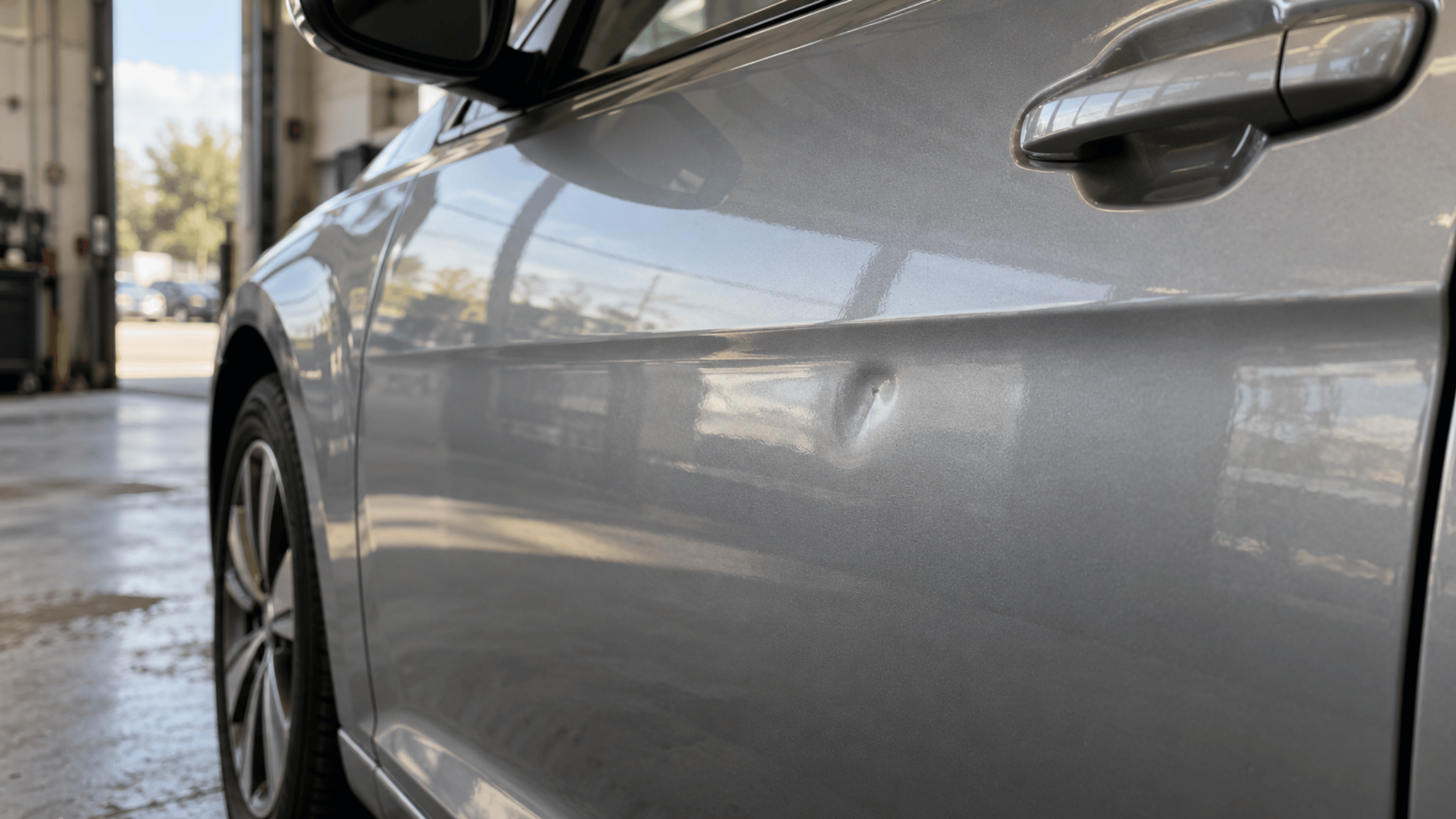
A shallow dent from another car’s door is a common PDR candidate, particularly when it sits in an accessible area away from a tightly folded edge.
However, two door dings that look similar can require different approaches. One may sit on an open section of the door skin, while another is directly over an internal reinforcement that restricts tool access.
A small dent is not automatically a simple repair.
Many Hail Dents
Paintless dent repair is frequently used for hail damage repair because hail can leave numerous dents while the factory paint remains intact.
A technician evaluates both the individual dents and the overall condition of each panel. A hood with scattered shallow dents presents a different repair challenge from a roof covered in deep, closely spaced impacts.
Severe hail damage may require a combination of methods. Some panels may be suitable for PDR, while others need conventional repair or replacement.
Shallow Dents on Larger Panels
A broad, shallow depression may be repairable without painting, even if it looks more noticeable than a small door ding.
Dent diameter alone does not determine repairability. A wide depression with relatively gentle contours can sometimes be a better candidate than a tiny, sharply pointed impact that has severely stretched the metal.
Some Creases and Body-Line Dents
A dent crossing a body line does not automatically rule out PDR. Experienced technicians can repair some creases and contour damage, depending on the metal, paint condition, severity, and access.
These repairs can be more demanding because the technician must restore a defined shape rather than a relatively flat surface.
An inspection is especially important before promising a particular result.
What Paintless Dent Repair Cannot Fix on Its Own
PDR has clear limits. Choosing it for unsuitable damage can leave an incomplete repair or create additional finish problems.
Chipped, Cracked, or Missing Paint
Moving the metal does not replace missing paint or repair a cracked clear coat.
If an impact leaves both a dent and a deep scratch, PDR might address part of the deformation, but additional finish work may still be necessary. Once refinishing is required, the job is no longer a complete paintless repair.
A technician should also consider the condition of previously repainted panels, particularly before using glue-pulling methods.
Severely Stretched, Torn, or Sharply Folded Metal
Metal can be displaced beyond what a paintless process can satisfactorily restore.
A deep impact, torn panel, or tightly folded edge may require conventional straightening, refinishing, or replacement. The manufacturer’s repair procedures and the panel’s material help determine what is appropriate.
Structural Damage or Broken Components
A dented exterior panel does not tell the whole story after a collision.
Damaged mounting points, bumper reinforcements, lighting, sensors, or structural components require their own evaluation and repair. Making the visible dent look better does not address those underlying problems.
If the damage followed a collision, start with a complete collision repair evaluation in Mesa rather than assuming the visible dent is the only issue.
Every Type of Bumper Damage
Most modern bumper covers are plastic, while conventional PDR focuses on metal panels.
A plastic bumper may be repairable using other methods, but a dented bumper cover should not automatically be treated like a door ding. Cracks, mounting damage, paint damage, and components behind the cover can all affect the repair plan.
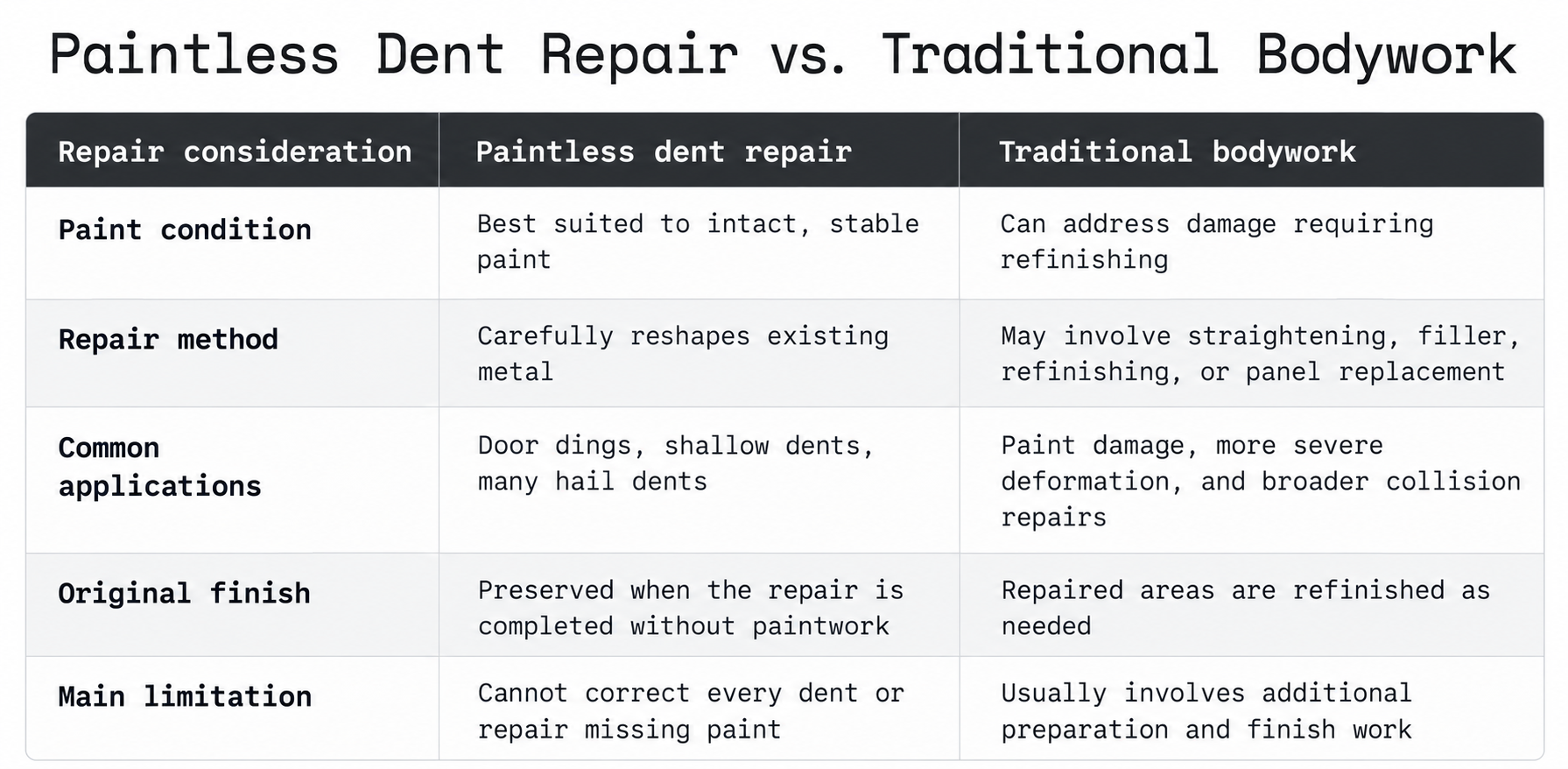
Paintless Dent Repair vs. Traditional Bodywork
Both methods have a place. The appropriate choice depends on what is damaged and what is needed to restore it properly.
How Much Does Paintless Dent Repair Cost?
For general budgeting, a small, accessible door ding may cost roughly $100 to $350. Larger dents, difficult creases, and restricted-access repairs can cost several hundred dollars or more. Multi-panel hail damage can reach thousands.
These are broad planning ranges, not Elite Automotive Finishes prices or a quote for your vehicle. Local labor rates and the actual damage can put a repair outside those ranges.
Paintless dent repair cost depends on more than dent size.
Depth and Sharpness
A sharply concentrated impact can require more time and precision than a wider, shallower depression.
Location and Access
Dents near panel edges, body lines, braces, or tightly enclosed areas can be harder to reach and reshape. Removing trim or interior components can add labor.
Panel Material
Steel and aluminum respond differently to repair. Aluminum PDR may require additional time and specialized experience, and manufacturer restrictions still apply.
Number of Dents
A single door ding and a hail-damaged roof are very different jobs. Hail estimates consider dent quantity, severity, affected panels, and related removal and installation work.
Paint and Previous Repairs
An older refinish, existing filler, or weakened paint adhesion can affect the repair method and the risk involved.
The most useful estimate explains both the expected result and what is included. Before approving work, review these questions to ask your auto repair shop before repairs.
Is Paintless Dent Repair Permanent?
A properly completed PDR repair is intended to be permanent. The technician reshapes the metal rather than temporarily concealing the dent beneath a coating or filler.
However, permanence and appearance are separate questions. Whether a dent can be removed to an acceptable finish depends on the damage and the technician’s assessment.
Ask what result is realistic before authorizing the repair. A promise that every dent will disappear completely, regardless of severity or paint condition, deserves scrutiny.
Why DIY Dent Pullers Do Not Always Deliver the Same Result
A suction cup or glue-pulling kit may move part of a dent, but moving metal is only one part of restoring a panel’s contour.
Pulling in the wrong place can create raised spots, leave surrounding distortion, or damage a compromised paint finish. Aggressive pushing from behind can also affect protective coatings on the panel’s underside, which may need to be restored after dent repair.
Professional PDR relies on controlled adjustments, visibility, access, and an understanding of how the panel responds. A dent that looks improved head-on may still show waves or high spots under reflected light.
If preserving the paint is your priority, have the damage assessed before experimenting with tools or heat.
FAQs About Paintless Dent Repair
Does Paintless Dent Repair Work on Aluminum?
Yes, some aluminum panels can be repaired using PDR. Suitability depends on the panel, damage, access, and applicable manufacturer procedures. Aluminum repairs can require different techniques and more time than comparable steel repairs.
Can PDR Remove a Dent If the Paint Is Scratched?
PDR may improve the metal’s shape, but it will not remove the scratch. A light surface mark and a scratch through the paint require different treatment. If refinishing is needed, PDR alone will not complete the repair.
How Long Does Paintless Dent Repair Take?
A straightforward ding may be completed within a few hours, while complex dents or extensive hail damage can take considerably longer. Access work, dent quantity, and repair difficulty all affect the schedule. Confirm the expected turnaround after inspection.
Is Every Hail-Damaged Car a Candidate for PDR?
No. Deep dents, damaged paint, extensive metal stretching, and manufacturer restrictions can make other methods necessary. Different panels on the same vehicle may need different repair approaches.
Looking for Dent Repair in Mesa, AZ?
You do not need to know the correct repair method before asking for an estimate. You need an evaluation that explains what is damaged, what can be repaired, and what result to expect.
At Elite Automotive Finishes, we offer free estimates for auto body and collision repairs in Mesa. If your vehicle has a door ding, dented panel, or storm damage, contact our shop to discuss the damage and available repair options, including whether PDR is appropriate.
Request an estimate and include your vehicle’s year, make, model, and clear photographs of the damaged area. An in-person inspection may be needed to confirm the repair approach and price.